Special votes explained: why the result can change after election night
About 700,000 special votes are expected in 2026. Here's who casts them, why they're counted later, how they've changed seat numbers before and when the official result lands.
In this guide
On election night you'll see a result that looks complete: every voting place reported, seat totals for every party. But a large slice of the vote is missing. Special votes, which were a fifth of all votes in 2023, are counted over the following weeks and only appear in the official result.
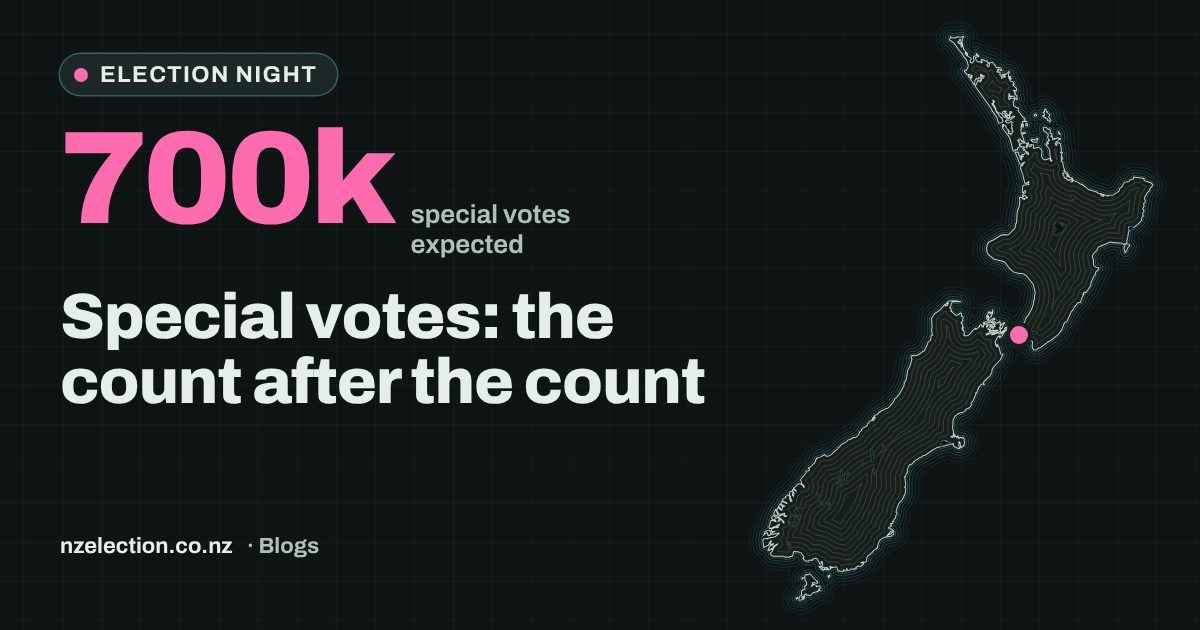
For 2026 the Electoral Commission expects about 700,000 special votes, more than ever. Here's what they are and why they matter.
Quick answer
- A special vote is any vote that can't go straight into the ballot box count, because the voter's details need checking first.
- They're not in the election night result. They're counted after checks and added to the official result on 27 November 2026.
- In 2023 there were 603,257 special votes, 20.9% of all votes.
- They've changed seat numbers at each of the last three elections, usually by one or two seats.
Who casts a special vote?
You cast a special vote if any of these apply:
- You enrolled after writ day, which was 4 October 2026. Enrolment closed at midnight on 25 October.
- You voted outside your electorate, for example while travelling or on holiday.
- You voted from overseas, by downloading and uploading your voting papers.
- You're on the unpublished roll, usually for safety reasons.
- Your name couldn't be found on the roll at the voting place, or you're on the dormant roll.
- You voted by dictation over the phone, a service for people who are blind, have low vision or can't mark a paper.
- You voted from hospital, a rest home or another place where staff brought the ballot to you.
A special vote goes into an envelope with a declaration. The Electoral Commission checks that you're eligible and haven't voted twice before your vote is counted.
Why there are so many in 2026
Several things push the number up this time.
- Late enrolment rules changed. The Electoral Amendment Act 2025 ended election day enrolment, and anyone who enrolled after writ day casts a special vote. Read what changed for 2026.
- Boundary changes. Several electorates were redrawn for 2026, and people voting outside their new electorate cast special votes. See the boundary changes.
- More people moving and travelling. Voting outside your electorate is common, especially at busy advance voting places in city centres.
- Overseas voters. Tens of thousands of New Zealanders abroad vote each time.
Special votes keep growing
- 2017446,287
- 2020504,621
- 2023603,257
- 2026~700,000
How special votes change the result
Special votes are counted for the party vote and, where the voter is enrolled in an electorate, for that electorate's candidates. Because people casting special votes tend to be younger, more mobile and more often overseas, they don't split the same way as ordinary votes. That's why the seat count often shifts.
Seats on election night vs the official result
2023
- National 50 → 48
- Green 14 → 15
- Te Pāti Māori 4 → 6
2020
- Labour 64 → 65
- National 35 → 33
- Māori Party 1 → 2
2017
- National 58 → 56
- Labour 45 → 46
- Green 7 → 8
The pattern at recent elections is a shift of one or two seats. That's often enough to matter: in a close Parliament, a single seat can decide whether a coalition has a majority.
Worth knowing: in 2023, National's seat total dropped from 50 on election night to 48 in the official result. That changed the arithmetic for forming a government and meant National needed both ACT and NZ First.
How long the count takes
The Electoral Commission has said it can't deliver official results in under 20 days, because each special vote has to be checked by hand before it's counted. The timeline for 2026 is:
| Step | When |
|---|---|
| Election day and preliminary count | Saturday 7 November |
| Special votes from overseas can arrive | Up to 10 days after election day |
| Checks of every special vote and the official count | Through November |
| Official results | Friday 27 November |
| Writ returned | Thursday 3 December |
During the official count, staff also recheck every voting place's ballot papers against the election night figures. Any errors are corrected.
Recounts
After the official result, a candidate can apply to a District Court judge for a recount in an electorate within three working days. A recount of the party vote nationally is rare. Recounts usually change only a handful of votes, but they matter when a seat is won by fewer than a few hundred.
How to read election night results with specials in mind
- Note which parties are close to a seat boundary. Under the Sainte-Laguë formula, the last few seats can tip either way. Our seat calculation guide shows why.
- Watch close electorates. A lead of a few hundred votes on election night is not safe.
- Look at past shifts. Specials have recently helped some parties more than others, but the pattern isn't fixed, and new rules this year could change it.
- Don't treat the night as final. News organisations will say "provisional" or "preliminary" for a reason.
Questions and answers
What are special votes in NZ?
Special votes are votes cast by people whose eligibility has to be checked before their vote is counted: late enrollers, people voting outside their electorate or overseas, and people on the unpublished roll, among others.
When are special votes counted?
After election day. Each one is checked first, then counted as part of the official count. The official result for 2026 is due on 27 November.
How many special votes will there be in 2026?
The Electoral Commission expects about 700,000, up from 603,257 in 2023.
Can special votes change who wins?
Yes. They changed seat totals in 2017, 2020 and 2023. In 2023 National lost two seats, and the Greens and Te Pāti Māori gained.
Is my vote a special vote if I voted early?
Not necessarily. Advance votes cast in your own electorate are ordinary votes and are counted on election night. Advance votes cast outside your electorate are special votes.
Sources
- Electoral Commission: special vote estimate for 2026, official results date and count process.
- 2023 New Zealand general election: preliminary and official seat totals.
- 2023 preliminary results release: special vote estimates for 2023.
This guide is general information about New Zealand elections, checked against the sources linked above on 3 November 2026. For anything about your own enrolment or vote, check vote.nz or call the Electoral Commission on 0800 36 76 56.
Keep reading
NZ election 2026 live results: when, where and how the vote count comes in
Live results for New Zealand's 2026 election start at 7pm on Saturday 7 November. Here's when each part of the vote count lands, where to follow it, and how to read it.
Why early election results can mislead: lessons from 2017, 2020 and 2023
Seat totals have changed after election night at each of the last three New Zealand elections. Here's what moved, why it happens, and how to avoid being fooled on 7 November.
How votes are counted in New Zealand, from ballot box to result
New Zealand still counts every vote by hand. Here's what happens to your ballot paper after you vote, step by step, from the sealed box to the live count and the official result.