New electorates for 2026: the boundary changes and renamed seats explained
The 2025 boundary review gave New Zealand 71 electorates for 2026, with new seats, abolished seats and new names. Here's what changed, why, and how it affects results night.
In this guide
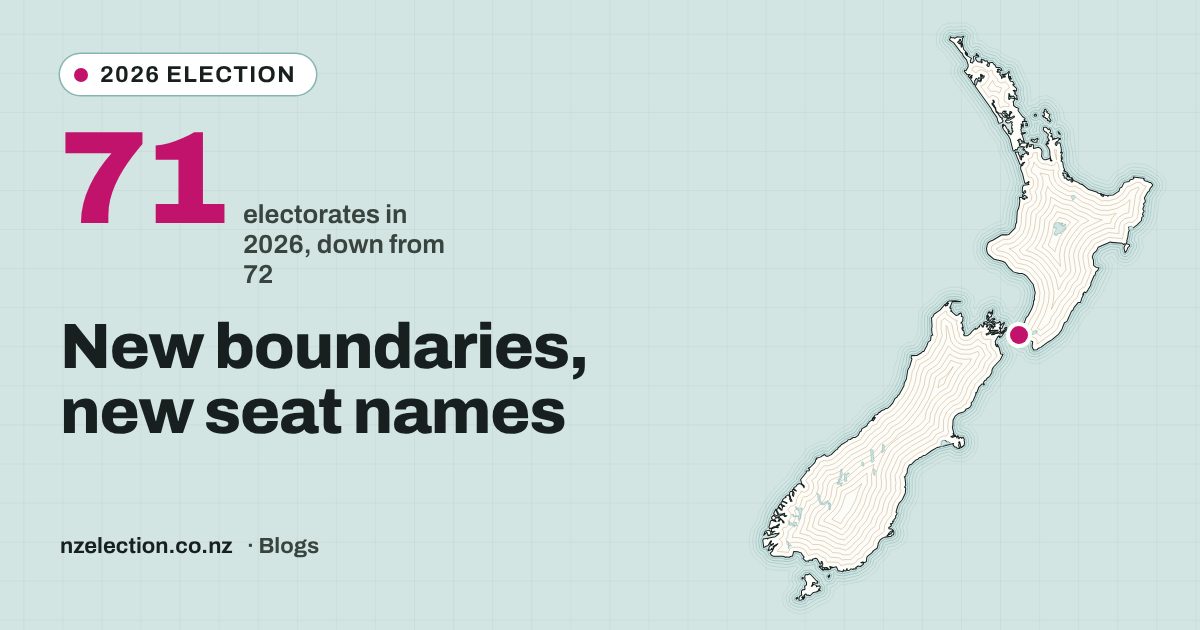
If your electorate has a new name this year, you're not imagining it. The Representation Commission redrew New Zealand's electorate boundaries in 2025, after the 2023 Census. For the 2026 election there are 71 electorates, one fewer than in 2023, and therefore 49 list seats instead of 48.
Here's what changed, why it happens, and what it means when you're watching the results.
Quick answer
- 71 electorates in 2026: 48 North Island general, 16 South Island general and 7 Māori electorates.
- The North Island lost one general electorate, because the South Island's share of the population grew relative to the North.
- Final boundaries were confirmed on 8 August 2025.
- Several seats were merged, split or renamed, especially in west Auckland and Wellington.
- Check your electorate at vote.nz.
Why boundaries change
After every five-yearly census and Māori Electoral Option, an independent Representation Commission reviews electorate boundaries. The rules are set in the Electoral Act:
- The South Island always has 16 general electorates. Its population is divided by 16 to get a quota.
- The North Island's number of general electorates is its population divided by that same quota.
- The number of Māori electorates depends on how many people of Māori descent choose the Māori roll.
- Each electorate must be within 5% of the quota for its type, so every vote carries similar weight.
- The total is 120 seats. List seats make up whatever electorates don't, so if electorates go down, list seats go up.
Because the South Island grew faster than the North relative to its 16-seat quota, the North Island dropped from 49 general electorates to 48.
Where the 120 seats come from in 2026
- 48 North Island general electorates
- 16 South Island general electorates
- 7 Māori electorates
- 49 list seats
The main changes for 2026
These are some of the most visible changes from the 2025 review. Some boundaries moved in almost every region, so check your own address on vote.nz.
| Area | 2023 electorates | 2026 electorates |
|---|---|---|
| West Auckland | New Lynn, Kelston, Te Atatū | Waitākere, Glendene, Henderson |
| South Auckland | Panmure-Ōtāhuhu | Ōtāhuhu |
| Bay of Plenty | Bay of Plenty | Mount Maunganui |
| Gisborne and East Coast | East Coast | East Cape |
| Wellington city | Wellington Central | Wellington North |
| Wellington city | Rongotai | Wellington Bays |
| Wellington region | Ōhāriu (abolished) | New seats of Kenepuru and Kapiti created |
Renamed seats aren't always the same seat with a new name. Many also gained or lost suburbs, so the voters inside them can be quite different from 2023.
What it means on election night
Boundary changes make comparisons with last time harder.
- No direct "last time" result. A new seat has no 2023 winner. Broadcasters and analysts use notional results, estimates of how the 2023 votes would have played out on the new boundaries.
- Notional margins can mislead. They're estimates, and candidates who held the old seat may be running in a quite different area.
- More special votes. People who moved, or who vote outside their new electorate, cast special votes, which are counted after election night. See special votes explained.
- The party vote isn't affected. Seat totals still come from the nationwide party vote.
Māori electorates
The number of Māori electorates stays at seven for 2026, the same as every election since 2002. Their boundaries are also reviewed, based on the Māori electoral population. Read Māori electorates explained.
How to find your electorate
- Go to vote.nz and use the electorate finder.
- Enter your address.
- You'll see your electorate, its candidates and your nearest voting places.
Your EasyVote card, if you got one, also shows your electorate.
Questions and answers
How many electorates are there in 2026?
71: 48 general electorates in the North Island, 16 in the South Island and 7 Māori electorates. There are 49 list seats.
Why did the number of electorates drop?
The South Island always has 16 general electorates, and the North Island's number is set by its population relative to the South's. After the 2023 Census, the North Island's entitlement fell from 49 to 48.
What happened to Wellington Central?
The seat has been replaced by Wellington North, and Rongotai by Wellington Bays, with boundaries redrawn across the city. Ōhāriu was abolished, and new Kenepuru and Kapiti seats were created in the region.
When were the new boundaries decided?
The Representation Commission confirmed final boundaries on 8 August 2025.
Does the boundary change affect how many seats a party gets?
Not directly. The party vote decides each party's share of the 120 seats. Boundaries decide who wins each electorate, which can matter for small parties and for overhang.
Sources
- Electoral Commission: Representation Commission 2025 final boundaries.
- vote.nz: electorate finder.
- 2026 New Zealand general election: electorate changes.
This guide is general information about New Zealand elections, checked against the sources linked above on 3 November 2026. For anything about your own enrolment or vote, check vote.nz or call the Electoral Commission on 0800 36 76 56.
Keep reading
NZ election 2026: everything you need to know
The 2026 New Zealand general election in one place: the date, key deadlines, how to vote, the parties and leaders, what's changed, and when and where to get the results.
The Māori electorates explained: seven seats, the Māori roll and 160 years of history
What the Māori electorates are, how the Māori roll and electoral option work, the seven seats in 2026, and how these seats have shaped results from 1867 to the 2023 overhang.
How to read election night results like a pro
Party vote or electorate vote? Percent counted or votes counted? A practical guide to reading New Zealand's live election results, with the traps that catch people out every time.