Overhang seats explained: why Parliament can have more than 120 MPs
New Zealand's Parliament is meant to have 120 seats, but in 2023 it had 122, then 123. Here's how overhang works, every time it's happened, and why it moves the majority line.
In this guide
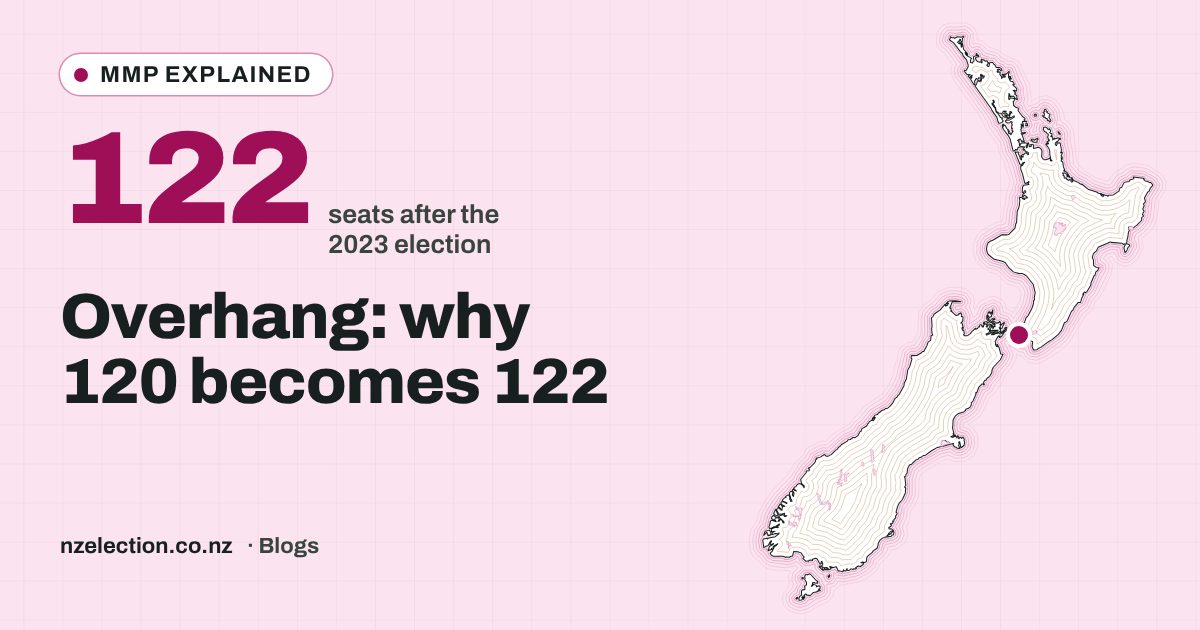
New Zealand's Parliament normally has 120 seats. But after the 2023 election it had 122, and after a by-election, 123. The reason is overhang, one of the quirks of MMP. It can move the majority line on election night, so it's worth understanding.
Quick answer
- Overhang happens when a party wins more electorate seats than its party vote entitles it to.
- The party keeps all its electorate seats, and other parties keep their full entitlement, so Parliament grows.
- In 2023, Te Pāti Māori won six electorates with a party vote worth about four seats, creating two overhang seats.
- More seats means a higher majority line: 62 of 122 instead of 61 of 120.
How overhang happens
Under MMP, the 120 seats are first shared out by party vote. Each party's electorate wins are counted inside its share, and list seats fill the rest. See how MMP works.
Usually a party wins fewer electorates than its total entitlement, so it gets list seats to make up the difference. But sometimes a party wins more electorates than its party vote justifies. It can't be given negative list seats, and electorate winners can't be unseated, so:
- the party keeps all its electorate seats,
- the other parties keep the seats their party vote entitles them to, and
- Parliament gets bigger by the number of extra seats.
Every overhang under MMP
| Election | Party with overhang | Overhang seats | Parliament size |
|---|---|---|---|
| 2005 | Māori Party | 1 | 121 |
| 2008 | Māori Party | 2 | 122 |
| 2011 | Māori Party | 1 | 121 |
| 2014 | United Future | 1 | 121 |
| 2023 | Te Pāti Māori | 2 | 122 |
There was no overhang in 1996, 1999, 2002, 2017 or 2020, so Parliament had exactly 120 seats after those elections. Overhang usually comes from parties that win electorates on strong local or Māori electorate support but have a smaller nationwide party vote.
Seats won at every MMP election, 1996 to 2023
- National
- Labour
- Green
- ACT
- NZ First
- Te Pāti Māori / Māori Party
- Other parties
The 2023 overhang, step by step
- Te Pāti Māori won 3.1% of the party vote, enough for about four seats.
- It won six of the seven Māori electorates.
- It kept all six, creating two overhang seats.
- Parliament had 122 seats, and a majority became 62.
- In the Port Waikato electorate, a candidate's death meant the electorate vote was held later, in a by-election on 25 November 2023. National won it. Because the party vote seats had already been allocated, the by-election winner was an extra MP, taking Parliament to 123.
The 2023 Parliament: 122 seats
- National
- Labour
- Green
- ACT
- NZ First
- Te Pāti Māori / Māori Party
Why overhang matters on election night
- The majority line moves. If there's one overhang seat, a majority is 61 of 121. With two, it's 62 of 122.
- Results can shift. Overhang depends on electorate results, and close electorates can change with special votes. In 2023, Te Pāti Māori had four seats on election night and six in the official result.
- Bloc arithmetic changes. A party's overhang seats count for whichever bloc it supports.
Is overhang fair?
Views differ:
- For keeping it: electorate MPs are directly elected and shouldn't be removed, and overhang is rare and small.
- Against it: it gives a party more seats than its party vote, so Parliament is less proportional than it should be.
- Reviews: both the Electoral Commission's 2012 MMP review and the Independent Electoral Review in 2023 recommended removing overhang seats, but the law hasn't changed. The rules for 2026 are the same as in 2023.
Questions and answers
What is an overhang seat?
An extra seat created when a party wins more electorates than its party vote entitles it to. The party keeps the electorates and Parliament grows above 120.
Why are there 122 or 123 MPs in New Zealand?
In 2023, Te Pāti Māori won two more electorates than its party vote justified, so Parliament had 122 seats. National's win in the Port Waikato by-election added another, making 123.
How many seats do you need for a majority if there's overhang?
More than half of the total. With 122 seats, a majority is 62.
Will there be overhang in 2026?
It depends on the results. It happens if any party wins more electorates than its party vote entitles it to.
Has overhang ever changed who governed?
Not so far, but it can matter in a close result. In 2023 it lifted the majority line from 61 to 62. National and ACT, with 59 seats between them, needed NZ First either way.
Sources
- Electoral Commission: overhang rules and 2023 official result.
- Te Ara: parties in Parliament 1999–2023.
- 2023 New Zealand general election: Port Waikato by-election and overhang.
This guide is general information about New Zealand elections, checked against the sources linked above on 3 November 2026. For anything about your own enrolment or vote, check vote.nz or call the Electoral Commission on 0800 36 76 56.
Keep reading
How MMP works in New Zealand: party vote, electorate vote and 120 seats
A clear explanation of New Zealand's MMP voting system: your two votes, how seats are shared out, list MPs, the 5% threshold, overhang and why coalitions are normal.
The Māori electorates explained: seven seats, the Māori roll and 160 years of history
What the Māori electorates are, how the Māori roll and electoral option work, the seven seats in 2026, and how these seats have shaped results from 1867 to the 2023 overhang.
How seats are calculated: the Sainte-Laguë method, with a worked example
New Zealand turns party votes into seats with the Sainte-Laguë formula. Here's how it works, step by step, with a simple worked example and the real 2023 numbers.