In this guide
Few countries have changed their voting system by asking voters directly. New Zealand did it twice in two years, in 1992 and 1993, and then asked again in 2011. The result was MMP, the system that has shaped every election since 1996.
Quick answer
- Under first past the post (FPP), the candidate with the most votes in each electorate won, and seats decided the government.
- In 1978 and 1981, Labour won more votes than National but fewer seats.
- A Royal Commission recommended MMP in 1986.
- 1992: 84.7% voted for change; 70.5% preferred MMP.
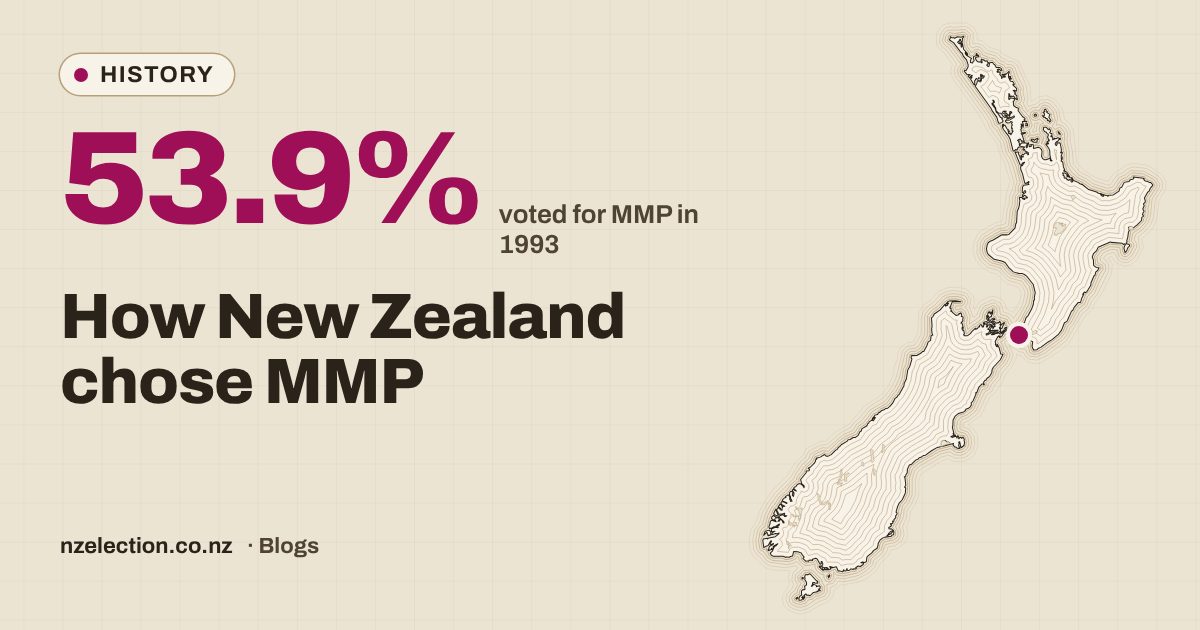
- 1993: 53.9% chose MMP over FPP in a binding referendum.
- 2011: 57.8% voted to keep MMP.
The problem with first past the post
Under FPP, each electorate elected one MP, whoever got the most votes. The party with the most seats formed the government. That's simple, but it can produce results that don't match how people voted:
- 1978: Labour won slightly more votes than National, but National won 51 seats to Labour's 40.
- 1981: Labour again won slightly more votes, but National won 47 seats to Labour's 43.
- Third parties: Social Credit won about 16% of the vote in 1978 and about 21% in 1981, but just one and two seats.
- 1984 to 1990: governments made sweeping reforms that many voters felt they hadn't voted for, adding to the push for change.
The Royal Commission, 1986
The Labour government elected in 1984 set up the Royal Commission on the Electoral System. Its 1986 report, Towards a Better Democracy, recommended MMP, modelled on West Germany's system. It suggested a Parliament of 120 MPs, half elected in electorates and half from party lists, with seats shared by party vote.
Neither major party was keen. But after promises to hold a referendum, and public frustration growing, the issue wouldn't go away.
1992: the indicative referendum
On 19 September 1992 voters were asked two questions.
- Part A: keep FPP or change? 84.7% voted for change.
- Part B: if there's a change, which system? MMP was the clear favourite.
1992 referendum, part B: which system?
- MMP70.5%
- STV17.4%
- PV6.6%
- SM5.5%
Turnout was only 55.2%, but the message was clear enough that the government agreed to a binding vote.
1993: the binding referendum
The binding referendum was held alongside the general election on 6 November 1993. It was a straight choice between FPP and MMP. Business groups funded a campaign for FPP, while the Electoral Reform Coalition campaigned for MMP.
1993 binding referendum: FPP or MMP?
- MMP53.9%
- FPP46.1%
MMP won with 53.86%, on a turnout of 85.2%. The first MMP election was held on 12 October 1996.
The first MMP election, 1996
The change was immediate. Six parties won seats, no party had a majority, and it took 65 days to form a government, a National and NZ First coalition. Parliament also became more diverse, with more women, Māori and Pacific MPs.
Seats won at every MMP election, 1996 to 2023
- National
- Labour
- Green
- ACT
- NZ First
- Te Pāti Māori / Māori Party
- Other parties
2011: keep MMP?
After five MMP elections, voters were asked whether to keep the system, alongside the 2011 general election.
2011 referendum: keep MMP?
- Keep57.8%
- Change42.2%
57.77% voted to keep MMP. Turnout in the referendum was 73.5%. Because MMP was kept, the Electoral Commission then reviewed how it worked and in 2012 recommended changes, including a lower 4% threshold and ending the one-electorate rule. Those changes weren't made. See the 5% threshold explained.
What the change meant
| Under FPP (to 1993) | Under MMP (from 1996) | |
|---|---|---|
| Seats decided by | Electorate wins | Party vote |
| Size of Parliament | 99 seats by 1993 | 120 seats, plus any overhang |
| Single-party majorities | Normal | Only once, in 2020 |
| Small parties | Rarely won seats | Regularly in Parliament |
| Government formation | Usually decided on election night | Often needs negotiation |
Questions and answers
Why did New Zealand change from FPP to MMP?
FPP produced results that didn't match the vote, like 1978 and 1981 when Labour won more votes but fewer seats. A Royal Commission recommended MMP, and voters chose it in referendums in 1992 and 1993.
What percentage voted for MMP in 1993?
53.86%, against 46.14% for FPP, on a turnout of 85.2%.
When was the first MMP election in New Zealand?
12 October 1996.
Did New Zealand vote to keep MMP?
Yes. In 2011, 57.77% voted to keep it.
What other systems were considered?
In 1992 voters were offered MMP, STV (single transferable vote), preferential voting and supplementary member. MMP won 70.5% of the vote in part B.
Sources
- Electoral Commission: referendum results 1992, 1993 and 2011.
- Election and Referendum 2011, official results.
- NZHistory: the road to MMP.
- Te Ara: electoral systems.
This guide is general information about New Zealand elections, checked against the sources linked above on 3 November 2026. For anything about your own enrolment or vote, check vote.nz or call the Electoral Commission on 0800 36 76 56.
Keep reading
How MMP works in New Zealand: party vote, electorate vote and 120 seats
A clear explanation of New Zealand's MMP voting system: your two votes, how seats are shared out, list MPs, the 5% threshold, overhang and why coalitions are normal.
A short history of New Zealand elections, 1853 to 2026
From 37 seats elected by property-owning men in 1853 to MMP and record early voting: the milestones, firsts and turning points in 170 years of New Zealand elections.
Every MMP election result, 1996 to 2023
Seats won by every party at all ten MMP elections, the largest party's vote, and the government that formed each time, from Bolger and Peters in 1996 to Luxon in 2023.